26.26
Martha Rosler The East Is Red, The West Is Bending
The East Is Red, The West Is Bending
More
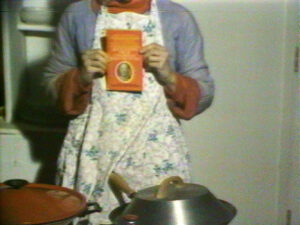
This instruction manual—an utterly preposterous text—serves as a kind of readymade script for Martha Rosler’s 1977 video, The East Is Red, The West Is Bending. Cooking instructions, safety warnings, cleaning tips, and repair advice are haphazardly interwoven with deeply objectionable stereotypes about Asian cuisine and culture. It speaks of the “Oriental” way of life and its purported emphasis on inner balance; of “exotic” ingredients such as ginger and seaweed; of the deliberate yet artfully staged simplicity of the food and its distinctive methods of preparation; and, time and again, in sweeping (and egregiously reductive) terms, of authenticity and spirituality.
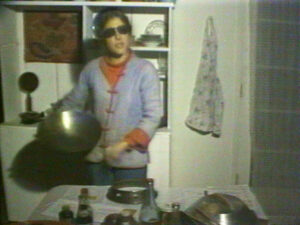
As she reads, the artist holds vegetables up to the camera, quickly chops them (the instruction recommends cutting at an angle rather than straight), presents a bottle of sake, or takes “chinaware”—that is, porcelain—from the shelf, which, according to the brochure, is meant to create an authentic atmosphere for entertaining guests. Every so often, she breaks the routine with a brief comic interlude, placing the lid of the bright red new wok on her head like a traditional Chinese conical hat, raising her leg to show the camera her foot in a classic Chinese peasant shoe, raiding the kitchen for cleaning products mentioned in the brochure, or holding a series of publications up to the camera: an issue of the English-language Peking Review, or books by Mao Zedong. “You remember him,” she says dryly to the camera of the Chairman of the Chinese Communist Party, who had died only shortly before.
With biting, subversive humor, Rosler dismantles the crude stereotypes underlying the Western appropriation of supposedly “Far Eastern” cultural practices, linking questions of food, cuisine, and the pursuit of status and social distinction through consumption to the geopolitical realities of the period and the ideological rivalry between the capitalist West and the communist East. It is a form of incisive ideological critique that plays out, quite literally, “at the kitchen table,” making the complexity of the larger political landscape tangible through the small scale of the seemingly private domestic sphere.
What the work makes visible, is the tangled, multilayered, and at times contradictory workings of these ideological constructs. What we see is not only a deeply problematic form of cultural appropriation, but also the enactment of Western fantasies of superiority and progress, finding its expression precisely in the purported celebration of an authentically simple “Oriental” cuisine—which allows for a framing of the American electric wok as a groundbreaking innovation, the superior alternative to its humble traditional Asian counterpart. At the same time, the video also makes palpable the relentless labor of self-perfection demanded of the consumer, for whom self-optimization becomes a means of acquiring status and social validation. It is no coincidence that by the end of The East Is Red, The West Is Bending, the protagonist appears so angry and overwhelmed that she concludes her presentation by urging viewers to please simply throw the American wok away.
In earlier works as well, the kitchen served Rosler as a central site of ideological contestation, and cooking as a profoundly political act in which relations of power—above all those of gender—are distilled. With Semiotics of the Kitchen (1975), she created a seminal work of feminist video art in which the kitchen appears as the paradigmatic space of women’s domestic labor. The year before, she had already produced the video collage, A Budding Gourmet, in which a monotonous female voice recounts the hope and expectation that improving—and above all internationalizing—her culinary skills will elevate her and her family’s social standing.
As the third video in this series, so to speak, The East Is Red, The West Is Bending combines questions of social status with the self-reflexive setting of the televised kitchen studio, shifting the focus even more explicitly to the intersection between the ostensibly informal (yet nonetheless political) level of the personal and the grand stage of “official” politics. Seen in retrospect, the cultural appropriation of “Asian cuisine” appears less as a counterpoint to the ideological hostility between the United States and China and the Cold War rivalry between capitalism and communism, than as something fully in step with the political developments of the period. In 1972, the staunch anti-communist Richard Nixon became the first U.S. president to visit Communist China. The visit marked the beginning of a rapprochement that culminated in the full normalization of diplomatic relations between the two countries in 1979—two years after Martha Rosler’s video—and ultimately paved the way for China’s later economic opening.
Looking back at this video today, one cannot help but feel that The East Is Red, The West Is Bending was made just as the era of postmodernism, the ascendancy of (neo)liberalism, and cultural and economic globalization—an era that now appears to be drawing to a close—was beginning. It is currently giving way to a new phase of isolationism, geopolitical realignment, China’s emergence as a global power, and a radically conservative turn in the West, particularly around questions of gender.
If we look for present-day equivalents in the realm of cooking and the kitchen, the so-called “trad wives” offer one example: impeccably turned-out women who conform to conventional gender roles and appear in their spacious, immaculate social media kitchens, effortlessly preparing elaborate meals for their families and, above all, for their husbands. What they cook is now largely hearty and “traditionally American-European,” bearing little resemblance to the international—and, indeed, often Asian-inspired—food trends that have shaped the restaurants of major cities and the kitchens of the liberal cosmopolitan elite over the past several decades. The ideological knot that Martha Rosler identified nearly fifty years ago—the complex intertwining of the public and the private, value production and projection, East and West, hard politics and cultural soft power, the individual and society—is anything but resolved. On the contrary, the video’s brilliant, scathing critique of these underlying mechanisms makes clear just how these strands are currently being woven together in new ways.
Martha Rosler lives and works in Brooklyn, New York. She is widely regarded as one of the most influential artists of her generation. Since the 1960s, her photomontages, videos, photographs, installations, and writings have addressed issues of public space and gentrification, gender politics, and the media’s representations of war, consistently taking an explicit political stance. Her work has been shown in numerous solo and group exhibitions, as well as biennials, including documenta in Kassel (1982 and 2007), the Venice Biennale (2003), Skulptur Projekte Münster (2007), and the major retrospectives, Positions in the Life World, at five European and US museums (1998–2000), and Irrespective at the Jewish Museum, New York (2018).
This instruction manual—an utterly preposterous text—serves as a kind of readymade script for Martha Rosler’s 1977 video, The East Is Red, The West Is Bending. Cooking instructions, safety warnings, cleaning tips, and repair advice are haphazardly interwoven with deeply objectionable stereotypes about Asian cuisine and culture. It speaks of the “Oriental” way of life and its purported emphasis on inner balance; of “exotic” ingredients such as ginger and seaweed; of the deliberate yet artfully staged simplicity of the food and its distinctive methods of preparation; and, time and again, in sweeping (and egregiously reductive) terms, of authenticity and spirituality.
As she reads, the artist holds vegetables up to the camera, quickly chops them (the instruction recommends cutting at an angle rather than straight), presents a bottle of sake, or takes “chinaware”—that is, porcelain—from the shelf, which, according to the brochure, is meant to create an authentic atmosphere for entertaining guests. Every so often, she breaks the routine with a brief comic interlude, placing the lid of the bright red new wok on her head like a traditional Chinese conical hat, raising her leg to show the camera her foot in a classic Chinese peasant shoe, raiding the kitchen for cleaning products mentioned in the brochure, or holding a series of publications up to the camera: an issue of the English-language Peking Review, or books by Mao Zedong. “You remember him,” she says dryly to the camera of the Chairman of the Chinese Communist Party, who had died only shortly before.
With biting, subversive humor, Rosler dismantles the crude stereotypes underlying the Western appropriation of supposedly “Far Eastern” cultural practices, linking questions of food, cuisine, and the pursuit of status and social distinction through consumption to the geopolitical realities of the period and the ideological rivalry between the capitalist West and the communist East. It is a form of incisive ideological critique that plays out, quite literally, “at the kitchen table,” making the complexity of the larger political landscape tangible through the small scale of the seemingly private domestic sphere.
What the work makes visible, is the tangled, multilayered, and at times contradictory workings of these ideological constructs. What we see is not only a deeply problematic form of cultural appropriation, but also the enactment of Western fantasies of superiority and progress, finding its expression precisely in the purported celebration of an authentically simple “Oriental” cuisine—which allows for a framing of the American electric wok as a groundbreaking innovation, the superior alternative to its humble traditional Asian counterpart. At the same time, the video also makes palpable the relentless labor of self-perfection demanded of the consumer, for whom self-optimization becomes a means of acquiring status and social validation. It is no coincidence that by the end of The East Is Red, The West Is Bending, the protagonist appears so angry and overwhelmed that she concludes her presentation by urging viewers to please simply throw the American wok away.
In earlier works as well, the kitchen served Rosler as a central site of ideological contestation, and cooking as a profoundly political act in which relations of power—above all those of gender—are distilled. With Semiotics of the Kitchen (1975), she created a seminal work of feminist video art in which the kitchen appears as the paradigmatic space of women’s domestic labor. The year before, she had already produced the video collage, A Budding Gourmet, in which a monotonous female voice recounts the hope and expectation that improving—and above all internationalizing—her culinary skills will elevate her and her family’s social standing.
As the third video in this series, so to speak, The East Is Red, The West Is Bending combines questions of social status with the self-reflexive setting of the televised kitchen studio, shifting the focus even more explicitly to the intersection between the ostensibly informal (yet nonetheless political) level of the personal and the grand stage of “official” politics. Seen in retrospect, the cultural appropriation of “Asian cuisine” appears less as a counterpoint to the ideological hostility between the United States and China and the Cold War rivalry between capitalism and communism, than as something fully in step with the political developments of the period. In 1972, the staunch anti-communist Richard Nixon became the first U.S. president to visit Communist China. The visit marked the beginning of a rapprochement that culminated in the full normalization of diplomatic relations between the two countries in 1979—two years after Martha Rosler’s video—and ultimately paved the way for China’s later economic opening.
Looking back at this video today, one cannot help but feel that The East Is Red, The West Is Bending was made just as the era of postmodernism, the ascendancy of (neo)liberalism, and cultural and economic globalization—an era that now appears to be drawing to a close—was beginning. It is currently giving way to a new phase of isolationism, geopolitical realignment, China’s emergence as a global power, and a radically conservative turn in the West, particularly around questions of gender.
If we look for present-day equivalents in the realm of cooking and the kitchen, the so-called “trad wives” offer one example: impeccably turned-out women who conform to conventional gender roles and appear in their spacious, immaculate social media kitchens, effortlessly preparing elaborate meals for their families and, above all, for their husbands. What they cook is now largely hearty and “traditionally American-European,” bearing little resemblance to the international—and, indeed, often Asian-inspired—food trends that have shaped the restaurants of major cities and the kitchens of the liberal cosmopolitan elite over the past several decades. The ideological knot that Martha Rosler identified nearly fifty years ago—the complex intertwining of the public and the private, value production and projection, East and West, hard politics and cultural soft power, the individual and society—is anything but resolved. On the contrary, the video’s brilliant, scathing critique of these underlying mechanisms makes clear just how these strands are currently being woven together in new ways.
Martha Rosler lives and works in Brooklyn, New York. She is widely regarded as one of the most influential artists of her generation. Since the 1960s, her photomontages, videos, photographs, installations, and writings have addressed issues of public space and gentrification, gender politics, and the media’s representations of war, consistently taking an explicit political stance. Her work has been shown in numerous solo and group exhibitions, as well as biennials, including documenta in Kassel (1982 and 2007), the Venice Biennale (2003), Skulptur Projekte Münster (2007), and the major retrospectives, Positions in the Life World, at five European and US museums (1998–2000), and Irrespective at the Jewish Museum, New York (2018).
Text Dominikus Müller
Translation Amy Patton
Martha Rosler
The East Is Red, The West Is Bending, 1977
Video, Farbe, Ton
20:25 Min.
Courtesy of Martha Rosler and Electronic Arts Intermix (EAI), New York.
Close
Translation Amy Patton
Martha Rosler
The East Is Red, The West Is Bending, 1977
Video, Farbe, Ton
20:25 Min.
Courtesy of Martha Rosler and Electronic Arts Intermix (EAI), New York.