23.25
Andro Eradze Flowering and Fading
Flowering and Fading
More
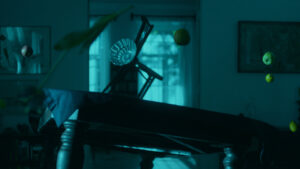
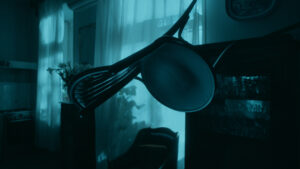
Something has happened and we don’t know what. But from this moment, the imagery slips into the surreal, like the spoon sliding over the sill. Objects begin to float: first the lamp, then the table and chairs. Fruit lifts from the bowl, and like drifting planets, apples and lemons glide through the air. The effect is that of the entire house slowly sinking to the bottom of the ocean, bringing everything inside down with it. And yet, its contents seem to drift free: disconnected, but not entirely independent. The mouse, meanwhile, has found refuge on a chair and now floats through the air as if on a plank at sea. Sounds of creaking floorboards and bending beams echo through the space, while the leaves of plants sway like meter-long strands of kelp under water. The whole scenario seems suspended, like the spoon tucked in thick honey: unreal, slowed, dragged in time. Mysterious.
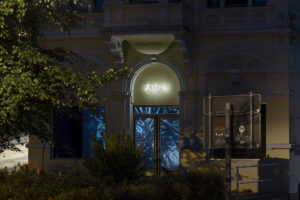
Finally, the camera shifts outside, probing the woods, bushes, and fields. An eerie light moves rapidly across the landscape, as if accelerated in time. Time seems to run both forward and backward: a directionless narrative that, stripped of orientation within the frame, gels, suspended, into pure atmosphere. A flower, fading on glowing embers, slowly loses its shape. The woman and dog lie in the grass. Fur and hair blur in close-up. A cut, a blink, a cut, a blink. The dog wakes, then suddenly lifts his head—he’s back inside the house, looking into the camera. Looking at us. Cut to black.
In essence, not much happens in Flowering and Fading, a fifteen-minute short film by Andro Eradze from 2024. It is a film of pure atmosphere, tension, and escalation—a slow build toward a climax that never quite arrives (or that perhaps consists in nothing more than a dog waking up). Nothing happens, and yet a great deal does. Or rather: nothing is there, and yet something is undeniably present. It is the classic setting of the horror film, here rendered as an evocation of the uncanny anchored not in what is shown, but in what is left unseen or suggested. Stripped of nearly all narrative ballast, the cinematic medium becomes a celebration of its own most fundamental means: the crafting of mood, the suspension of disbelief in something supernatural—which ultimately always points back to film itself, that wondrous doubling of reality.
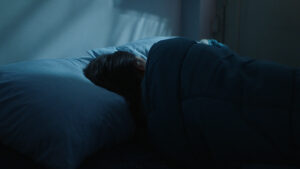
The nighttime setting, the motif of sleep and awakening (the latter bringing the haunting to an end), already frames the scene as that of a dream (a dream within a dream even?). But who or what was dreaming? The woman? The dog? The mouse? The camera? The artist? Us? The boundaries between various actors—human and non-human alike, including animals but also the wind, the forest, the house and the honey, the leaves, the light, the creaking and gusting sounds, as well as all the other cinematic means at play—begin to dissolve and flow into a suspended, in-between space where it no longer matters whether things are resting on the ground or drifting through the air.
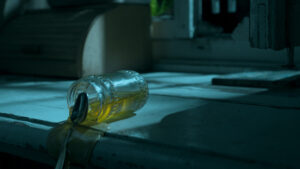
The tipped-over jar of honey, its thick contents slowly spilling out, spoon and all, is the central scene of Flowering and Fading: the hinge connecting inside and outside, nature and the supernatural, dream and reality. It is this sequence, this improbable image of a spoon not falling but flowing downward, that opens the door to the improbable, the floating, the drifting, the dreamlike. What came before felt uncanny and enchanted; now everything appears displaced and impossible—and yet no less true.
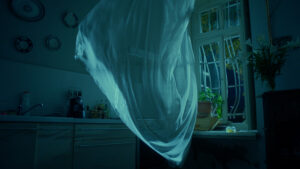
This central scene in Flowering and Fading faintly echoes a key moment from the history of European avant-garde cinema: the infamous eye-slicing shot in Luis Buñuel and Salvador Dalí’s surrealist masterpiece Un Chien Andalou (1929). Where here, thick honey flows from an overturned jar, there, a gelatinous fluid oozes from a slashed eye. And just as Un Chien Andalou attacks the act of seeing itself—placing the visible per se under scrutiny—Eradze’s film, through slowing down motion (and thus one of cinema’s defining traits), makes a subject of movement itself as it coagulates into a picture. In both films, the cut and the flow respectively become portals to the surreal and the dreamlike. In 1929, a radical incision takes an earlier visual motif—a crescent moon traversed by a long, thin cloud—and completes it, seeing it to its conclusion with a perfect match cut; in 2024, a billowing curtain, swollen inward into the room, finds its echo in the slow, viscous spill of honey.
Where Un Chien Andalou delivers a brutal, abrupt cut (in accordance with historical Surrealism’s self-styled understanding as a radical break with tradition), Flowering and Fading offers a slow, viscous spilling-over—a gradual in-folding that slowly tips. One might read this as a visual metaphor for the shift in the technical dispositif behind the moving image itself. Analog film was, quite literally and physically, cut: it was only through the technique of montage, i.e. the process of slicing and joining individual frames of celluloid, that cinematic dreamscapes were possible. Digital film—as used in Flowering and Fading—is by contrast no longer “cut” in the traditional, physical sense. Pixels, individual points of light in a grid, simply change their intensity and color to make new images appear. Rather than a radical rupture, we find a steady but continuous transformation: a constant flowering and fading, perpetual blooming and withering, flickering and dimming. The dense leaves seen in the film, lit by artificial light and in constant motion, can no longer be fixed into a single coherent source; they hover between brightness and shadow, engulfing and unsettling both the image as a whole and the viewer. In doing so, they supply the film with a central metaphor: a dance of points of light that no longer animates one image after another in sequence, but introduces movement into the image itself.
These slow, “morphing” transformations can also be found in other films by Eradze, which, with a finely tuned sensitivity to ominous, highly affective atmospheres, blur the boundaries between humans, animals, plants, and technical devices—in other words, between “human agents” and “other-than-human agents.” All of them masterfully bring the inanimate to life. After all, animating the dead is not only a hallmark of the horror genre (whose logic of suspense Flowering and Fading makes legible and exhibitable as an aesthetic experience in itself) but also of the sublime illusion-machine that is cinema as a whole.
Andro Eradze lives and works in Tbilisi, Georgia. His artworks and films have featured in numerous exhibitions and film festivals, including the New Museum, New York, USA (2021); the 59th Venice Biennale, Venice, Italy (2022); the 22nd Sesc_Videobrasil Biennial, São Paulo, Brazil; the 14th Kaunas Biennial, Kaunas, Lithuania (all in 2023); at SpazioA, Pistoia,; Artissima in Turin; the 9th Biennale Gherdëina, Val Gardena, all Italy; Haus der Kulturen der Welt, Berlin, Germany (all in 2024); as well as at MoMA PS1, New York, and the International Film Festival Rotterdam, Netherlands (both in 2025). In 2023, he completed the residency program at WIELS in Brussels, Belgium.
Something has happened and we don’t know what. But from this moment, the imagery slips into the surreal, like the spoon sliding over the sill. Objects begin to float: first the lamp, then the table and chairs. Fruit lifts from the bowl, and like drifting planets, apples and lemons glide through the air. The effect is that of the entire house slowly sinking to the bottom of the ocean, bringing everything inside down with it. And yet, its contents seem to drift free: disconnected, but not entirely independent. The mouse, meanwhile, has found refuge on a chair and now floats through the air as if on a plank at sea. Sounds of creaking floorboards and bending beams echo through the space, while the leaves of plants sway like meter-long strands of kelp under water. The whole scenario seems suspended, like the spoon tucked in thick honey: unreal, slowed, dragged in time. Mysterious.
Finally, the camera shifts outside, probing the woods, bushes, and fields. An eerie light moves rapidly across the landscape, as if accelerated in time. Time seems to run both forward and backward: a directionless narrative that, stripped of orientation within the frame, gels, suspended, into pure atmosphere. A flower, fading on glowing embers, slowly loses its shape. The woman and dog lie in the grass. Fur and hair blur in close-up. A cut, a blink, a cut, a blink. The dog wakes, then suddenly lifts his head—he’s back inside the house, looking into the camera. Looking at us. Cut to black.
In essence, not much happens in Flowering and Fading, a fifteen-minute short film by Andro Eradze from 2024. It is a film of pure atmosphere, tension, and escalation—a slow build toward a climax that never quite arrives (or that perhaps consists in nothing more than a dog waking up). Nothing happens, and yet a great deal does. Or rather: nothing is there, and yet something is undeniably present. It is the classic setting of the horror film, here rendered as an evocation of the uncanny anchored not in what is shown, but in what is left unseen or suggested. Stripped of nearly all narrative ballast, the cinematic medium becomes a celebration of its own most fundamental means: the crafting of mood, the suspension of disbelief in something supernatural—which ultimately always points back to film itself, that wondrous doubling of reality.
The nighttime setting, the motif of sleep and awakening (the latter bringing the haunting to an end), already frames the scene as that of a dream (a dream within a dream even?). But who or what was dreaming? The woman? The dog? The mouse? The camera? The artist? Us? The boundaries between various actors—human and non-human alike, including animals but also the wind, the forest, the house and the honey, the leaves, the light, the creaking and gusting sounds, as well as all the other cinematic means at play—begin to dissolve and flow into a suspended, in-between space where it no longer matters whether things are resting on the ground or drifting through the air.
The tipped-over jar of honey, its thick contents slowly spilling out, spoon and all, is the central scene of Flowering and Fading: the hinge connecting inside and outside, nature and the supernatural, dream and reality. It is this sequence, this improbable image of a spoon not falling but flowing downward, that opens the door to the improbable, the floating, the drifting, the dreamlike. What came before felt uncanny and enchanted; now everything appears displaced and impossible—and yet no less true.
This central scene in Flowering and Fading faintly echoes a key moment from the history of European avant-garde cinema: the infamous eye-slicing shot in Luis Buñuel and Salvador Dalí’s surrealist masterpiece Un Chien Andalou (1929). Where here, thick honey flows from an overturned jar, there, a gelatinous fluid oozes from a slashed eye. And just as Un Chien Andalou attacks the act of seeing itself—placing the visible per se under scrutiny—Eradze’s film, through slowing down motion (and thus one of cinema’s defining traits), makes a subject of movement itself as it coagulates into a picture. In both films, the cut and the flow respectively become portals to the surreal and the dreamlike. In 1929, a radical incision takes an earlier visual motif—a crescent moon traversed by a long, thin cloud—and completes it, seeing it to its conclusion with a perfect match cut; in 2024, a billowing curtain, swollen inward into the room, finds its echo in the slow, viscous spill of honey.
Where Un Chien Andalou delivers a brutal, abrupt cut (in accordance with historical Surrealism’s self-styled understanding as a radical break with tradition), Flowering and Fading offers a slow, viscous spilling-over—a gradual in-folding that slowly tips. One might read this as a visual metaphor for the shift in the technical dispositif behind the moving image itself. Analog film was, quite literally and physically, cut: it was only through the technique of montage, i.e. the process of slicing and joining individual frames of celluloid, that cinematic dreamscapes were possible. Digital film—as used in Flowering and Fading—is by contrast no longer “cut” in the traditional, physical sense. Pixels, individual points of light in a grid, simply change their intensity and color to make new images appear. Rather than a radical rupture, we find a steady but continuous transformation: a constant flowering and fading, perpetual blooming and withering, flickering and dimming. The dense leaves seen in the film, lit by artificial light and in constant motion, can no longer be fixed into a single coherent source; they hover between brightness and shadow, engulfing and unsettling both the image as a whole and the viewer. In doing so, they supply the film with a central metaphor: a dance of points of light that no longer animates one image after another in sequence, but introduces movement into the image itself.
These slow, “morphing” transformations can also be found in other films by Eradze, which, with a finely tuned sensitivity to ominous, highly affective atmospheres, blur the boundaries between humans, animals, plants, and technical devices—in other words, between “human agents” and “other-than-human agents.” All of them masterfully bring the inanimate to life. After all, animating the dead is not only a hallmark of the horror genre (whose logic of suspense Flowering and Fading makes legible and exhibitable as an aesthetic experience in itself) but also of the sublime illusion-machine that is cinema as a whole.
Andro Eradze lives and works in Tbilisi, Georgia. His artworks and films have featured in numerous exhibitions and film festivals, including the New Museum, New York, USA (2021); the 59th Venice Biennale, Venice, Italy (2022); the 22nd Sesc_Videobrasil Biennial, São Paulo, Brazil; the 14th Kaunas Biennial, Kaunas, Lithuania (all in 2023); at SpazioA, Pistoia,; Artissima in Turin; the 9th Biennale Gherdëina, Val Gardena, all Italy; Haus der Kulturen der Welt, Berlin, Germany (all in 2024); as well as at MoMA PS1, New York, and the International Film Festival Rotterdam, Netherlands (both in 2025). In 2023, he completed the residency program at WIELS in Brussels, Belgium.
Text Dominikus Müller
Translation Amy Patton
Flowering and Fading, 2024
Video, 4K, 16:22 min.
Courtesy the artist, Lo schermo Dell’arte, Fondazione in Between Art Film and SpazioA Pistoia
Close
Translation Amy Patton
Flowering and Fading, 2024
Video, 4K, 16:22 min.
Courtesy the artist, Lo schermo Dell’arte, Fondazione in Between Art Film and SpazioA Pistoia