25.26
Adrian Piper Adrian Moves to Berlin
Adrian Moves to Berlin
More
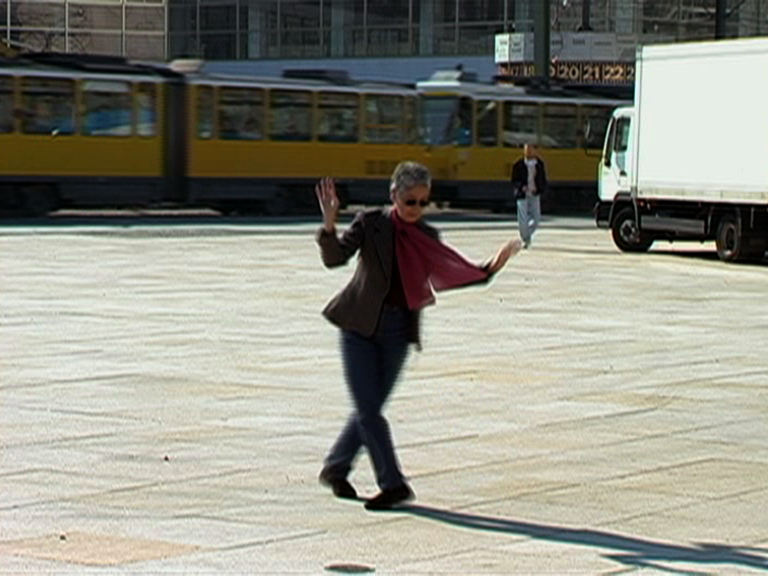
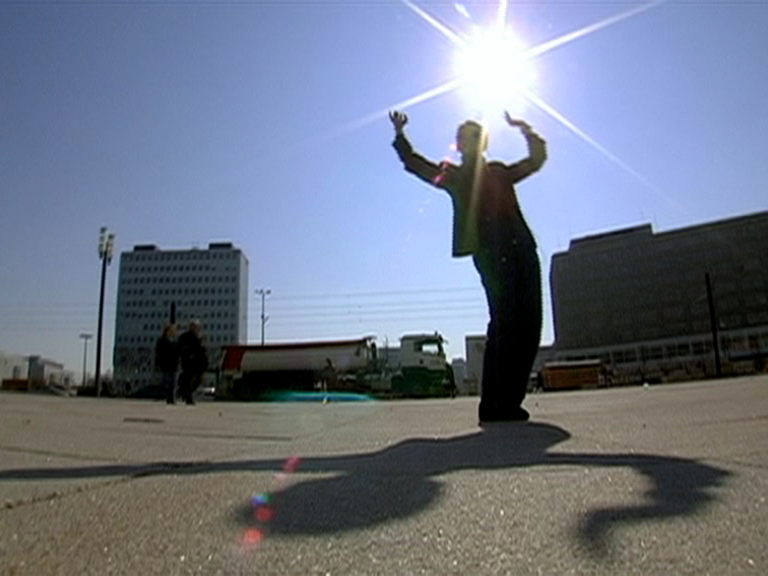
Occasionally someone glances her way; for a brief moment, a teenager mockingly imitates her movements before moving on. A tram passes through the frame, the sun shines in a clear blue sky, and construction equipment in the background signals a city in transition, as Berlin certainly was at the time, nearly twenty years ago.
At the time of the performance, Piper had just permanently turned her back on the United States, where she was born and raised and where, since the 1960s, she had been active not only as an artist but also as a professor of analytic philosophy at several universities. As the title of her autobiographical book Escape to Berlin: A Travel Memoir (2018) suggests, the move was less a relocation than a flight from the structural racism and institutionalized discrimination in the United States that Piper, who “has decided to retire from being black”¹ in 2012, had criticized for decades. In 2008, a year after the performance, Wellesley College moved to terminate Piper’s tenured professorship after she refused to return to the United States while her name remained on an official list of so-called “suspicious travelers.”
Adrian Moves to Berlin, however, could be understood not only as a direct reference to the artist’s relocation but also in the sense that she is “moving to Berlin” here, more precisely, moving to the sound of the city. In a short text about the work on her website, Piper notes that the music to which she danced consists of “selected Berlin house music from the early 2000s”²—a genre that, in fact, owes much to Black American club music. In this respect, the performance pays tribute not only to the role dance clubs played in Berlin in bringing East and West together after the fall of the Wall, as the text notes, but also to a deeper transatlantic cultural exchange between Berlin’s club culture and musical styles that were far more marginalized in the United States.
(As an aside: the fact that this short text foregrounds the word work, suggesting that the piece can be understood both as a celebration of this “work” and as a homage to East Berlin as the capital of a now-vanished workers’ state, can also be read as another play on the shifting meanings of the term across the US–Germany axis. When, in the context of American—and especially queer Black—club culture, one hears expressions such as “work it,” “work your body,” and the like, this is of course a direct invitation to dance. But it also operates as a layered reference to the many forms of the “work of the body,” understood as an irreducible site entangled with economic, sexual, and racialized regimes.)
Music has featured repeatedly in Adrian Piper’s artistic practice since at least the 1970s; it can be understood as a marker of cultural difference and hierarchy, an expression of self-confidence or self-empowerment, as well as a means of creating temporary situations of cross-boundary solidarity. After beginning her career in the context of Conceptual art in the second half of the 1960s, Piper—who, incidentally, worked as a dancer in New York discos when she was young—turned increasingly to questions of racism and gender-based repression. She often embedded these concerns in didactic or experimental settings enabling broader reflections on social positioning, situated perspectives, and abstract systems.
An earlier work bears mentioning here: Funk Lessons, a performance first presented in 1983, repeated several times, documented on video, and later revisited in the form of a public discussion. In it, Piper teaches her audience how to dance to funk music. In a deliberately didactic manner, the artist breaks down supposedly “intuitive” dance movements into concrete, teachable steps while explaining the history and context of this music, which originated in Black working-class culture and, at the time, was largely rejected by the American middle class. Eventually, the lessons turn into a relaxed party. Everyone dances, seemingly shifting from head to body, and the boundaries drawn along the lines of class and race appear to fall away—if only for a brief moment. The piece feels like a concrete exercise, driven by the force of music, in imagining a more open and tolerant society: one that, for all its immersion in the moment, does not lose sight of its specific context and background but instead builds on them and grows out of them.
And so now—just as once on Alexanderplatz—viewers stand before the shop window at ajh.pm, watching Adrian Piper dance. The difference is that anyone who steps close enough can now also hear the music to which she dances in the video. Nothing prevents passersby from joining in and dancing in the street themselves. Yet the explicit art context, the mediation of the image, and the accompanying information introduce a level of intellectual reflection that may not have been present for passersby in quite the same way in the performance’s original setting. As if in an experimental setup, viewers find themselves thrown back on their own position, prompted to consider their own role and place. But head and body need not be opposed. In bodily movement, thought too is set in motion—even if only in the form of a momentary suspension, like an arm thrown into the air or a balancing step to the side.
Adrian Piper (b. 1948, USA) began producing conceptual work in the 1960s, soon addressing political themes such as racism and gender roles. Alongside her artistic practice, she pursued an academic career as an analytic philosopher and received numerous research fellowships in that field. After earning her PhD from Harvard University in 1981, she taught at several universities in the United States until 2008, when Wellesley College, her then employer, terminated her professorship after she refused to return from Berlin—where she has lived and worked since 2005—to the United States while her name remained on an official list of “suspicious travelers.” Piper has received numerous awards for her artistic work, including the Golden Lion at the 2015 Venice Biennale, the Käthe Kollwitz Prize of the Akademie der Künste in 2018—of which she has been a member since that year—the Goslarer Kaiserring in 2021, and the Harvard Arts Medal in 2023. Her work is held in numerous collections, including the Museum of Modern Art and the Metropolitan Museum of Art, both New York; the Centre Pompidou, Paris; and the Museum of Contemporary Art, Los Angeles, and has been the subject of several major retrospectives, including one at the Museum of Modern Art, New York, in 2018. In March 2024, her most recent retrospective exhibition, RACE TRAITOR, opened at PAC Milan.
At the time of the performance, Piper had just permanently turned her back on the United States, where she was born and raised and where, since the 1960s, she had been active not only as an artist but also as a professor of analytic philosophy at several universities. As the title of her autobiographical book Escape to Berlin: A Travel Memoir (2018) suggests, the move was less a relocation than a flight from the structural racism and institutionalized discrimination in the United States that Piper, who “has decided to retire from being black”¹ in 2012, had criticized for decades. In 2008, a year after the performance, Wellesley College moved to terminate Piper’s tenured professorship after she refused to return to the United States while her name remained on an official list of so-called “suspicious travelers.”
Adrian Moves to Berlin, however, could be understood not only as a direct reference to the artist’s relocation but also in the sense that she is “moving to Berlin” here, more precisely, moving to the sound of the city. In a short text about the work on her website, Piper notes that the music to which she danced consists of “selected Berlin house music from the early 2000s”²—a genre that, in fact, owes much to Black American club music. In this respect, the performance pays tribute not only to the role dance clubs played in Berlin in bringing East and West together after the fall of the Wall, as the text notes, but also to a deeper transatlantic cultural exchange between Berlin’s club culture and musical styles that were far more marginalized in the United States.
(As an aside: the fact that this short text foregrounds the word work, suggesting that the piece can be understood both as a celebration of this “work” and as a homage to East Berlin as the capital of a now-vanished workers’ state, can also be read as another play on the shifting meanings of the term across the US–Germany axis. When, in the context of American—and especially queer Black—club culture, one hears expressions such as “work it,” “work your body,” and the like, this is of course a direct invitation to dance. But it also operates as a layered reference to the many forms of the “work of the body,” understood as an irreducible site entangled with economic, sexual, and racialized regimes.)
Music has featured repeatedly in Adrian Piper’s artistic practice since at least the 1970s; it can be understood as a marker of cultural difference and hierarchy, an expression of self-confidence or self-empowerment, as well as a means of creating temporary situations of cross-boundary solidarity. After beginning her career in the context of Conceptual art in the second half of the 1960s, Piper—who, incidentally, worked as a dancer in New York discos when she was young—turned increasingly to questions of racism and gender-based repression. She often embedded these concerns in didactic or experimental settings enabling broader reflections on social positioning, situated perspectives, and abstract systems.
An earlier work bears mentioning here: Funk Lessons, a performance first presented in 1983, repeated several times, documented on video, and later revisited in the form of a public discussion. In it, Piper teaches her audience how to dance to funk music. In a deliberately didactic manner, the artist breaks down supposedly “intuitive” dance movements into concrete, teachable steps while explaining the history and context of this music, which originated in Black working-class culture and, at the time, was largely rejected by the American middle class. Eventually, the lessons turn into a relaxed party. Everyone dances, seemingly shifting from head to body, and the boundaries drawn along the lines of class and race appear to fall away—if only for a brief moment. The piece feels like a concrete exercise, driven by the force of music, in imagining a more open and tolerant society: one that, for all its immersion in the moment, does not lose sight of its specific context and background but instead builds on them and grows out of them.
And so now—just as once on Alexanderplatz—viewers stand before the shop window at ajh.pm, watching Adrian Piper dance. The difference is that anyone who steps close enough can now also hear the music to which she dances in the video. Nothing prevents passersby from joining in and dancing in the street themselves. Yet the explicit art context, the mediation of the image, and the accompanying information introduce a level of intellectual reflection that may not have been present for passersby in quite the same way in the performance’s original setting. As if in an experimental setup, viewers find themselves thrown back on their own position, prompted to consider their own role and place. But head and body need not be opposed. In bodily movement, thought too is set in motion—even if only in the form of a momentary suspension, like an arm thrown into the air or a balancing step to the side.
Adrian Piper (b. 1948, USA) began producing conceptual work in the 1960s, soon addressing political themes such as racism and gender roles. Alongside her artistic practice, she pursued an academic career as an analytic philosopher and received numerous research fellowships in that field. After earning her PhD from Harvard University in 1981, she taught at several universities in the United States until 2008, when Wellesley College, her then employer, terminated her professorship after she refused to return from Berlin—where she has lived and worked since 2005—to the United States while her name remained on an official list of “suspicious travelers.” Piper has received numerous awards for her artistic work, including the Golden Lion at the 2015 Venice Biennale, the Käthe Kollwitz Prize of the Akademie der Künste in 2018—of which she has been a member since that year—the Goslarer Kaiserring in 2021, and the Harvard Arts Medal in 2023. Her work is held in numerous collections, including the Museum of Modern Art and the Metropolitan Museum of Art, both New York; the Centre Pompidou, Paris; and the Museum of Contemporary Art, Los Angeles, and has been the subject of several major retrospectives, including one at the Museum of Modern Art, New York, in 2018. In March 2024, her most recent retrospective exhibition, RACE TRAITOR, opened at PAC Milan.
Text Dominikus Müller
Translation Amy Patton
Adrian Piper
Adrian Moves to Berlin
2007, performance; 2017, video projection
Endless loop as video projection (color, sound)
01:02:42 min
Video Robert Del Principe
Collection of the Adrian Piper Research Archive Foundation
© Adrian Piper Research Archive Foundation
1 http://www.adrianpiper.com/edinburgh/news_sep_2012.shtml, last accessed 13 March 2026; see also: http://www.adrianpiper.com/edinburgh/removed-and-reconstructed-en.wikipedia-biography.shtml, last accessed 13 March 2026
2 http://www.adrianpiper.com/edinburgh/vs/video_am.shtml, last accessed 13 March 2026
Close
Translation Amy Patton
Adrian Piper
Adrian Moves to Berlin
2007, performance; 2017, video projection
Endless loop as video projection (color, sound)
01:02:42 min
Video Robert Del Principe
Collection of the Adrian Piper Research Archive Foundation
© Adrian Piper Research Archive Foundation
1 http://www.adrianpiper.com/edinburgh/news_sep_2012.shtml, last accessed 13 March 2026; see also: http://www.adrianpiper.com/edinburgh/removed-and-reconstructed-en.wikipedia-biography.shtml, last accessed 13 March 2026
2 http://www.adrianpiper.com/edinburgh/vs/video_am.shtml, last accessed 13 March 2026