24.25
Christine Gensheimer Work in ProRes
Work in ProRes
More
It becomes an apt description of what much of an animation artist’s daily practice consists in, namely sustained engagement with the very tools that, as modes of production, open certain possibilities while foreclosing others.
At the same time, Gensheimer’s direct reference to the technological underpinnings of digital image processing takes a distinctive turn. Her films inhabit the transitional zones between the analogue and the digital, in that perplexing simultaneity of overlapping dispositives—or rather, where the old extends into the new. This extension carries with it a faintly melancholic awareness of what once seemed self-evident but, stripped of its naturalness (“denaturalized,” so to speak), can now be isolated and contemplated at a remove. Such distance, however, comes at a price: it can never fully detach from the new dispositive that both enables its presentation and conditions its perception. This compression and torsion of one into the other ultimately gives rise to a distinctive fusion: an aesthetic of media-technical hybridity.
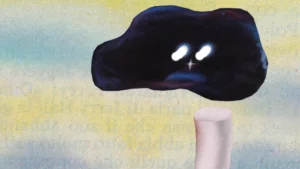
This becomes particularly evident in the distinctive textures of Gensheimer’s animated films, where look and style carry as much weight as the generally loosely structured, dreamlike, open-ended narratives that serve as their “content.” (This heightened role of surface makes her films—which often originate as music videos—“pop” works in their own right.) Gensheimer draws her source material from analogue print media: from books on medieval art to computer magazines, niche periodicals, and even children’s textbooks. One of her primary tools is the scanner, that bridging technology through which analogue, “material” images from the world of print are transposed into the supposedly immaterial, screen-based realm of the digital. From there, she works in a modular way, assembling new images from discrete elements: turning planes into spaces, piecing together arms, legs, torsos, and heads into newly imagined bodies.
The images that emerge through this process carry hallmarks of the analogue into the digital. Again and again, faint traces of text from the reverse side of the scanned material bleed through like windblown remnants of an earlier context, pointing to a (not-altogether-distant) yesterday just beneath the present. Gensheimer also uses the halftone dots of offset printing as a deliberate stylistic device, giving her own images, when enlarged, a distinctive “rawness” and an intentionally unnatural quality—even as this analogue “grain,” under digital conditions, appears curiously smooth and (contrary to the usual associations) all the more artificial. Work in ProRes is far from using digital means to simulate the analogue or indulge nostalgia. Rather, what comes into view is the reciprocal yet never fully resolved interlacing of the two aesthetics. Much appears subtly warped or askew, an effect heightened by the schematically stilted movements characteristic of classic stop-motion animation.
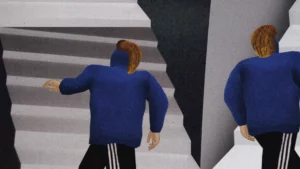
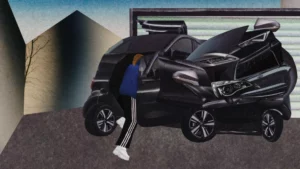
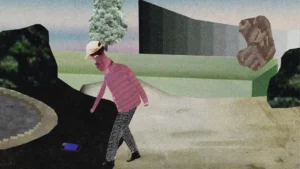
And then there is the animation itself. The work’s title already points to it: the “progress” hidden within ProRes—as if behind a typographical slip—can also be read as the continual motion that underlies all animation. We watch the film’s figures stumble and drift through ever-shifting pictorial spaces to an electropop soundtrack by Berlin-based musician Saeko Killy, dressed in hip Adidas track pants and chunky Buffalo shoes. They climb staircases that split and branch like those in the prints of Piranesi or M. C. Escher; they wander through more or less abstract domestic interiors constructed from the simplest of planes; they stroll down streets, only to turn back again. They climb into gloriously dented cars—almost cubist collisions of themselves that look as if they’ve crashed into their own reflections—and speed off. They swipe the screens of phones and tablets (which, in an ironic twist, have of course been scanned from printed magazines), until new spaces open at the center of the frame, almost as if the image were turning itself inside out. It is a walk without destination, a state of perpetual motion, and in this looped film, quite literally, a walk in circles. One is never quite sure whether one is inside or outside, in space or on a surface, in the analogue or the digital. Or somehow occupying both at once.
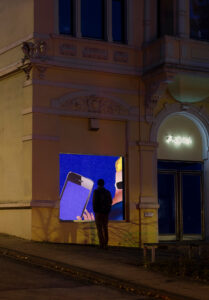
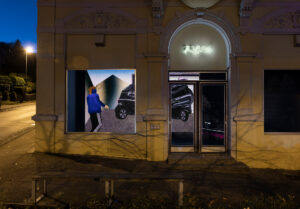
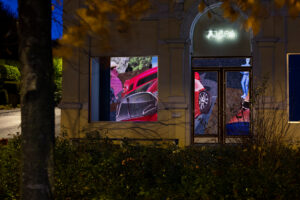
In a sense, the loop in Work in ProRes—this continual transformation, this folding of one dimension into another—could be said to extend all the way into the physical space of its presentation at ajh.pm. The exhibition venue, marking its fifth anniversary with this show, itself follows a logic of the image contained within space: moving-image works on view remain visible even after hours, through a large street-facing window; the gallery projects its image, as it were, outward into the urban sphere. One thus finds oneself in a peculiar entanglement as well, standing on the street and looking in—through a framing window onto a screen. And it is there, peering at one frame nested within another, that we watch figures moving through public space, down the street, swiping the screens of their own devices. Until yet another image appears, another space opens. Folding inward, unfolding outward. Inside turns into outside, yesterday into today. Back and forth. And once again from the beginning.
Christine Gensheimer (b. 1976 in Frankfurt am Main) lives and works in Bielefeld. Her videos have been shown at institutions including Kunstmuseum Wolfsburg, Kunsthalle Düsseldorf, and Bielefelder Kunstverein, as well as at numerous film festivals, most recently at the 70th International Short Film Festival Oberhausen, the European Union Short Film Festival in Ottawa, and Filmfest Dresden. Her works are held in public and private collections including the Kunsthalle Bielefeld, the Viehof Collection, and the Stiftung für die Linie Collection. Since 2005, Gensheimer has produced animated films with Timo Katz for the ARTE program Karambolage, as well as for various museums. She has also created a number of music videos for artists including Jaakko Eino Kalevi, Sean Armstrong (Spinning Coin, Slipper), and Saeko Killy.
At the same time, Gensheimer’s direct reference to the technological underpinnings of digital image processing takes a distinctive turn. Her films inhabit the transitional zones between the analogue and the digital, in that perplexing simultaneity of overlapping dispositives—or rather, where the old extends into the new. This extension carries with it a faintly melancholic awareness of what once seemed self-evident but, stripped of its naturalness (“denaturalized,” so to speak), can now be isolated and contemplated at a remove. Such distance, however, comes at a price: it can never fully detach from the new dispositive that both enables its presentation and conditions its perception. This compression and torsion of one into the other ultimately gives rise to a distinctive fusion: an aesthetic of media-technical hybridity.
This becomes particularly evident in the distinctive textures of Gensheimer’s animated films, where look and style carry as much weight as the generally loosely structured, dreamlike, open-ended narratives that serve as their “content.” (This heightened role of surface makes her films—which often originate as music videos—“pop” works in their own right.) Gensheimer draws her source material from analogue print media: from books on medieval art to computer magazines, niche periodicals, and even children’s textbooks. One of her primary tools is the scanner, that bridging technology through which analogue, “material” images from the world of print are transposed into the supposedly immaterial, screen-based realm of the digital. From there, she works in a modular way, assembling new images from discrete elements: turning planes into spaces, piecing together arms, legs, torsos, and heads into newly imagined bodies.
The images that emerge through this process carry hallmarks of the analogue into the digital. Again and again, faint traces of text from the reverse side of the scanned material bleed through like windblown remnants of an earlier context, pointing to a (not-altogether-distant) yesterday just beneath the present. Gensheimer also uses the halftone dots of offset printing as a deliberate stylistic device, giving her own images, when enlarged, a distinctive “rawness” and an intentionally unnatural quality—even as this analogue “grain,” under digital conditions, appears curiously smooth and (contrary to the usual associations) all the more artificial. Work in ProRes is far from using digital means to simulate the analogue or indulge nostalgia. Rather, what comes into view is the reciprocal yet never fully resolved interlacing of the two aesthetics. Much appears subtly warped or askew, an effect heightened by the schematically stilted movements characteristic of classic stop-motion animation.
And then there is the animation itself. The work’s title already points to it: the “progress” hidden within ProRes—as if behind a typographical slip—can also be read as the continual motion that underlies all animation. We watch the film’s figures stumble and drift through ever-shifting pictorial spaces to an electropop soundtrack by Berlin-based musician Saeko Killy, dressed in hip Adidas track pants and chunky Buffalo shoes. They climb staircases that split and branch like those in the prints of Piranesi or M. C. Escher; they wander through more or less abstract domestic interiors constructed from the simplest of planes; they stroll down streets, only to turn back again. They climb into gloriously dented cars—almost cubist collisions of themselves that look as if they’ve crashed into their own reflections—and speed off. They swipe the screens of phones and tablets (which, in an ironic twist, have of course been scanned from printed magazines), until new spaces open at the center of the frame, almost as if the image were turning itself inside out. It is a walk without destination, a state of perpetual motion, and in this looped film, quite literally, a walk in circles. One is never quite sure whether one is inside or outside, in space or on a surface, in the analogue or the digital. Or somehow occupying both at once.
In a sense, the loop in Work in ProRes—this continual transformation, this folding of one dimension into another—could be said to extend all the way into the physical space of its presentation at ajh.pm. The exhibition venue, marking its fifth anniversary with this show, itself follows a logic of the image contained within space: moving-image works on view remain visible even after hours, through a large street-facing window; the gallery projects its image, as it were, outward into the urban sphere. One thus finds oneself in a peculiar entanglement as well, standing on the street and looking in—through a framing window onto a screen. And it is there, peering at one frame nested within another, that we watch figures moving through public space, down the street, swiping the screens of their own devices. Until yet another image appears, another space opens. Folding inward, unfolding outward. Inside turns into outside, yesterday into today. Back and forth. And once again from the beginning.
Christine Gensheimer (b. 1976 in Frankfurt am Main) lives and works in Bielefeld. Her videos have been shown at institutions including Kunstmuseum Wolfsburg, Kunsthalle Düsseldorf, and Bielefelder Kunstverein, as well as at numerous film festivals, most recently at the 70th International Short Film Festival Oberhausen, the European Union Short Film Festival in Ottawa, and Filmfest Dresden. Her works are held in public and private collections including the Kunsthalle Bielefeld, the Viehof Collection, and the Stiftung für die Linie Collection. Since 2005, Gensheimer has produced animated films with Timo Katz for the ARTE program Karambolage, as well as for various museums. She has also created a number of music videos for artists including Jaakko Eino Kalevi, Sean Armstrong (Spinning Coin, Slipper), and Saeko Killy.
Text Dominikus Müller
Translation Amy Patton
Work in ProRes, 2025
Video Loop, HD, 04:21 min.
Sound and Music Saeko Killy
Courtesy Christine Gensheimer
Photos Philipp Ottendörfer
Close
Translation Amy Patton
Work in ProRes, 2025
Video Loop, HD, 04:21 min.
Sound and Music Saeko Killy
Courtesy Christine Gensheimer
Photos Philipp Ottendörfer